Although totodiles don’t have the actual Ability Dancer, many totodile trainers teach their totodiles to dance as a way to direct their playful energy toward something other than biting what they shouldn’t.
The reason the totodile line “cries” is because, when they eat, they swallow too much air, which triggers their lachrymal glands and makes tears flow. Some of them induce this deliberately to persuade their trainers to do something for them, but their crying does not mean they are genuinely sad. The totodile line displays real sadness through a lack of energy and enthusiasm, drooping body language, and a refusal to eat; they often end up taken to Pokémon Centres because their trainers believe they are sick.
It is true that a croconaw doesn’t let go of its foe until it loses its fangs (or its trainer tells it to– it is a lot easier to train this behavior when it is still a totodile), but it is actually very easy to hold a croconaw’s mouth closed to prevent it from biting in the first place; their muscles to open their jaws are extremely weak, and humans can hold croconaws’ mouths shut with their bare hands. However, muzzles are inhumane, and simply training a croconaw not to bite while it’s still a totodile is the best method.
The gender of baby totodiles is determined based on the temperature at which their eggs are kept during the middle third of the incubation process. They become male when kept at intermediate temperatures, and female when kept at either extreme. Because most totodiles are hatched in temperate areas, they are more likely to hatch male both in the wild and captivity.
For awhile, researchers were unsure if “feraligatr” should be spelled the way it is or if an “o” should be included to make it “feraligator”. In the end, the semi-official decision was put to a feraligatr itself, who was presented with two pieces of paper. It ate the paper with the incorrect spelling, and the matter was decided.
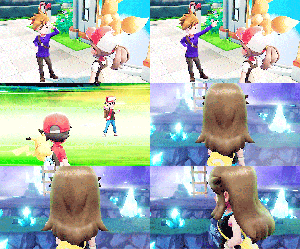
The latest trailer and news for Pokémon Let’s Go, Pikachu! & Let’s Go, Eevee has been released. This information showcases Givoanni and the Elite Four as well as the inclusion of Red, Blue and even the female trainer known in the manga as Green.










 Only Seven Acres of Rose of Pollux's Musings & Daydreams